GitHub Copilot is moving to usage-based billing - here’s what it really means
Cristian Olivera
May 20, 2026 · 7 min read
GitHub is officially ending its flat-fee billing model for Copilot. Starting June 1, 2026, every plan transitions to AI Credits - token-based billing tied to actual usage. Code completions stay free. But if you rely on agents or premium chat models, the math changes significantly.
Let me be honest with you before we move ahead. GitHub’s announcement landed quietly on April 27 and most developers glossed over it - until they ran the numbers on the official simulator and realized how heavily their workflow depends on agents and premium models.
If all you do is code completions, relax. This barely affects you. But if you run Copilot Workspace tasks, ask Claude or GPT-4o questions daily, or let agents crawl your entire repo… keep reading.
The Moment of Truth
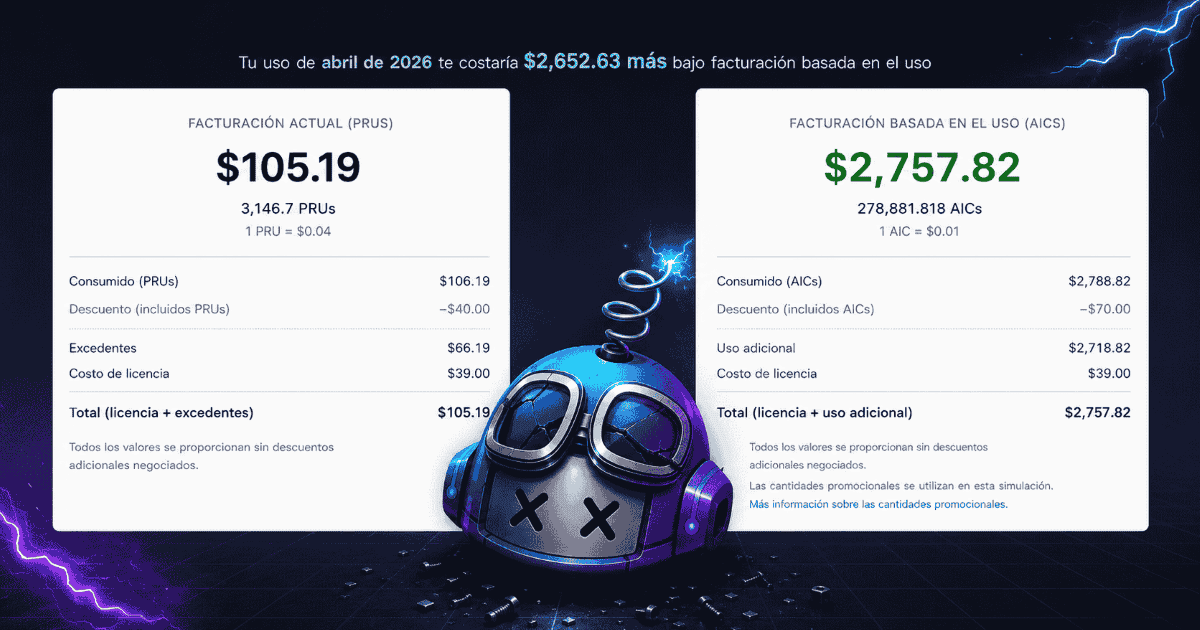
GitHub launched a billing preview tool in early May so teams can see their projected costs before June 1. I plugged in my team of 7 (Copilot Business, heavy agent usage) and this is what came back:
Current Billing
$0.00
USD / month
New Simulated Bill
$0.00
USD / month
Monthly Overage
+$0.00
× 3.6 for heavy agent users
That’s a 3.6x increase - for a team that heavily relies on Copilot agents. For teams that mainly use code completions with occasional chat, the impact is far smaller. The new model favors lighter users; power agent users absorb most of the cost change.
Run your own numbers using the official tool before June 1. The results will vary a lot depending on how agent-heavy your workflow is.
What Actually Changed
The old Copilot billing charged a flat monthly fee and let you rack up PRUs (premium request units) for chat and agents until you hit the monthly cap. Code completions were always free.
The new AI Credits model keeps completions free but replaces PRUs with token-based consumption for every chat message and agent task. Each plan now includes a dollar-for-dollar credit allowance:
| Feature | Old (PRU) Model | New AI Credits |
|---|---|---|
| Code completions | Unlimited FREE | Still unlimited FREE |
| Next Edit suggestions | Unlimited FREE | Still unlimited FREE |
| Chat – base models | PRU-capped (~300/mo Pro) | Token-based from included credits |
| Chat – premium (GPT-4o, Claude) | PRU-capped, limited | Token-based · higher API rate |
| Agent / Workspace tasks | PRUs consumed per request | $1–$20+ per long task |
| Automated code review | Limited PRUs | Tokens + GitHub Actions minutes |
Why GitHub Did This
The answer isn't complicated: AI agents are expensive, and someone has to pay for them.
When Copilot was just code completions, the cost per user was predictable and relatively low. But Copilot Workspace, multi-file edits, and full-codebase agents can consume thousands of tokens per session. A single agent task that refactors a large codebase might cost GitHub more than an entire monthly subscription.
By switching to token-based billing, GitHub ensures power users pay proportionally more while keeping completions free for everyone. They also gain the ability to remove the fallback-to-cheaper-model behavior, which was degrading reliability for lighter users.
“The unlimited flat rate was never a business model - it was a customer acquisition strategy. Now that Copilot is embedded in millions of workflows, the real pricing begins.”
The Numbers in Context
Enough theory - let's talk real numbers. Here are three typical developer profiles and their estimated monthly cost under the new AI Credits model:
| Profile | Typical usage | Old flat rate | New estimated bill |
|---|---|---|---|
Light user | Completions only + occasional chat message | $10/mo | ≈$10–12/mo |
Regular dev | Completions + daily base-model chat + occasional agent task | $10/mo | ≈$18–40/mo |
Power user | Workspace/agent tasks daily, premium models (GPT-4o, Claude) | $10/mo | ≈$80–300+/mo |
To simulate your own exact bill, use the official GitHub tool at copilot-billing-preview.github.com - available from your Billing Overview page on github.com once it rolls out in early May.
Who Gets Hit Hardest
After crunching the numbers, three groups are going to feel this the most:
Small agencies
Multiple seats with agent usage will feel the biggest absolute dollar increase. Teams of 5–20 developers running Workspace tasks daily could easily see 3–10x cost jumps.
Power solo devs
If you rely on Copilot to analyze full repos, run multi-step refactors, or chain agent tasks - you will blow past your included credits fast.
Complex codebases
Monorepos and enterprise apps mean more tokens per agent prompt. The bigger the context, the higher the credit consumption per task.
Alternatives Worth Considering
If the new pricing doesn't work for your workflow, the good news is that the AI coding tools market in 2026 is incredibly competitive. Here are the strongest alternatives:
Cursor
The AI-first code editor
Flat monthly pricing
Built-in Claude & GPT-4o
Context-aware edits
Not a VS Code extension
Smaller ecosystem
Windsurf
Agentic IDE by Codeium
Generous free tier
Cascade agent built-in
Works offline (limited)
Newer, smaller community
Some rough edges
Continue.dev
Open-source AI assistant
100% open source
Use your own API keys
VS Code + JetBrains
More setup required
No built-in models
Claude
Fastest completions available
Extremely fast completions
Free tier available
Low latency
Less conversational features
No agent capabilities
What You Should Do Right Now
Here's your action plan before June 2026:
- Run the official preview - Go to copilot-billing-preview.github.com and enter your actual usage. It’s available via your Billing Overview on github.com.
- Know what's free - Code completions and Next Edit suggestions consume zero credits. If your workflow is completion-heavy and chat-light, your bill barely changes.
- Audit agent usage - Track how often you actually run Workspace or multi-step agent tasks. This is where the cost lives.
- Talk to your team / manager - If you're on a Business plan, start the budget conversation now. Business gets promotional credits for June–August, which softens the initial transition.
- Explore alternatives - Cursor and Windsurf offer flat-rate plans that include agent usage. If agents are central to your workflow, they might work out cheaper.
- Annual plan subscribers - You stay on PRU-based pricing until your plan expires. At renewal you’ll transition, or you can convert early for prorated credits.
#GitHubCopilot #AI #SoftwareEngineering #Coding #TechTrends #GitHub
Share this post